A harness turns design decisions into a repeatable path. I define the rules, tokens, and checks that keep this site consistent, then agents build inside that system. Every change is testable before it ships. Here, ‘deterministic’ means every page change follows the same rules, checks, and ship path — even when agents write part of the code.
A harness makes design work repeatable: these four parts stay constant on every page.
Source — The editable source of truth: markdown, tokens, and specs.
Bake — Scripts compile that source into the live HTML page.
Proof — Lint, audits, and gates catch spacing drift, token drift, and structural errors before deploy.
Shared system — One shared system for me and agents — contracts keep layout, spacing, and taste from being reinvented on each pass.
How a page gets built based on the core idea
Every page follows the same five stages from source to ship. That fixed path is what makes the system deterministic.
Example: if an agent introduces spacing outside the approved scale or changes a token unexpectedly, the pre-ship gate stops the build. Each stage has a clear owner: some steps are mine, some are the agent’s, and some are shared.
Who is involved in each stage
Me
Agent
Source
and — I define copy, structure, and spacing decisions at the source.
Sync
— the agent turns markdown and tokens into the live HTML page.
Proof
, , and — the agent runs checks that block spacing drift, token drift, and invalid changes.
Refine
and — we refine the result until the design, copy, spacing, and structure are correct.
Ship
— one command ships the checked build once every gate passes.
The harness map
Each folder exists to make agent-driven changes safer, more consistent, and easier to verify before deploy.
9 work showcases · 20+ components · 13 share previews · 1 design system
diagram-bake/Turns framework-based diagrams into exportable PNG assets.
og-bake/Generates share cards from a single reusable template.
components/Reusable interaction patterns and UI building blocks.
work-detail/Showcase layouts built from shared system rules.
ship-log/A log of what shipped and when.
Tools I build with
Tap a tool to see how it fits the harness.
Setup your own harness
Agents keep reinventing layout and ship steps — or rebuilding what already works. Install the diy-harness skill once. First pass: a readiness score and a short task list you pick from. Nothing installs until you choose. Setup is the next step.
What this skill will change
Looks at your project first and writes a short audit before changing anything.
Gives you a readiness score and a short task list. You pick what to do next — or all of the above. Nothing installs until you choose. Setup is the next step.
If you already have parts of a harness, it looks for those first and offers to combine — not rebuild.
It won’t delete your files or copy this site’s folder names onto yours.
Works even without a code repo (Carrd, a CMS, no Git) — you get simple docs and checklists, not fake code folders.
If you already use design-lint or bake-the-brief, it points you there instead of rebuilding those tools. The plan may suggest adding one later; never required.
Weekly check-ins suggest fixes; nothing applies until you approve.
How DIY-harness works
When designers build with coding agents, every session can reinvent tokens and deploy rituals. A harness holds the path together.
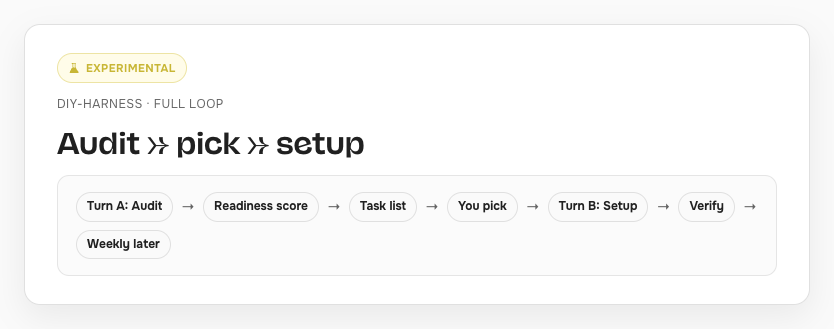
Full loop
1 / 5
Audit and score first. You pick tasks. Setup only after you choose — then verify, with a weekly check-in later.
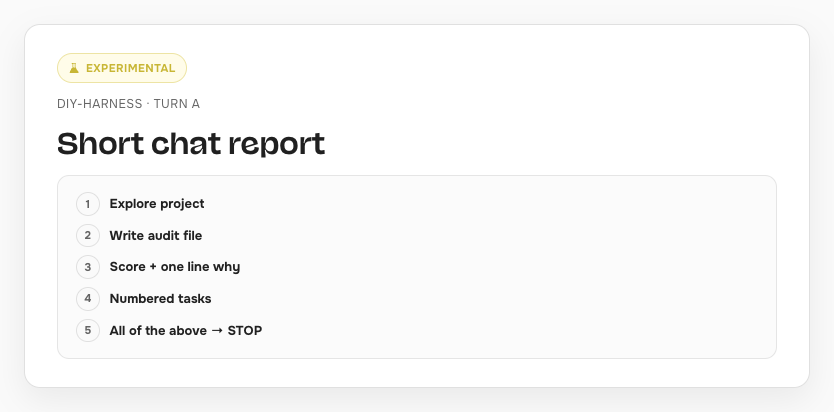
First pass stays short in chat: explore, write an audit file, score, numbered tasks, then stop and wait.
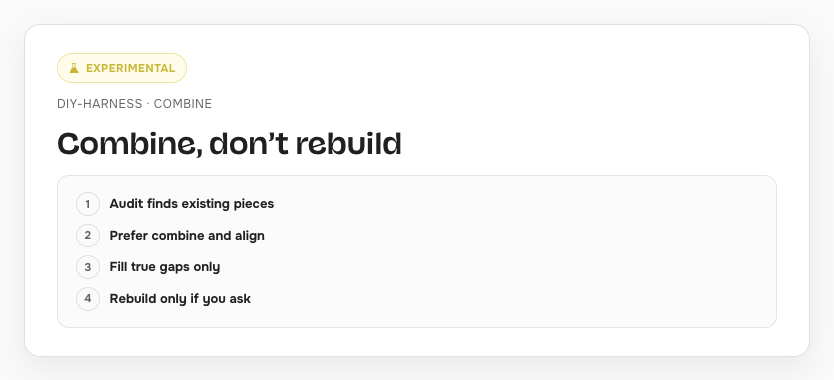
If pieces already exist, the default is combine and align — fill gaps only. Rebuild only if you ask.
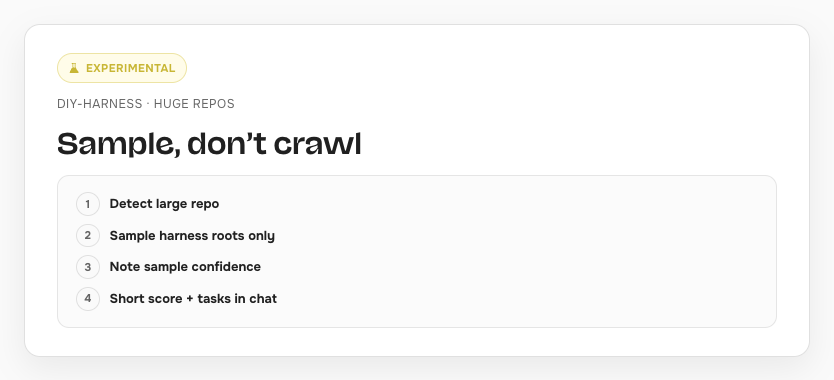
On a large monorepo it samples harness-related roots and notes confidence — it does not dump the whole tree into chat.
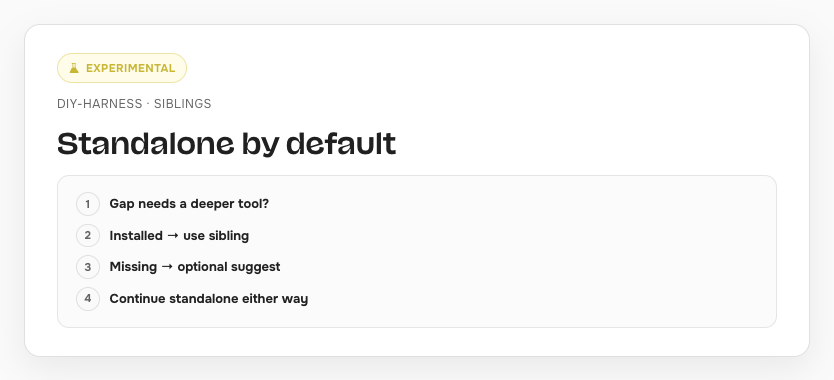
diy-harness stands alone. Sibling skills may be suggested later — never required, never blocking.
1AuditLooks at your project and writes a short audit doc before anything is installed.
2ReadinessScores how ready the project is for a harness, not how neat the repo looks.
3PlanShort numbered task list you pick from (or all of them). Nothing installs until you choose.
4SetupInstalls only the tasks you picked. Never rebuilds what already works.
5WeeklySuggests a drift check-in. You approve before any fixes apply.
---
name: diy-harness
description: >
Audit a site, app, or project, score harness readiness (0–1), list numbered
tasks, then set up only what the human picks so coding agents stop reinventing
layout, tokens, and ship rituals. Turn A = audit + score + task list (no
setup). Turn B = chosen tasks only. Standalone by default; optional siblings
may be suggested. Use when the user says "setup my harness", "DIY harness",
"setup your own harness", "audit harness readiness", "make agent changes
safer", or "stop reinventing tokens every session".
---
> Mirrored from [iruhdam1/skills · diy-harness](https://github.com/iruhdam1/skills/tree/main/skills/diy-harness). Not a skill for this website repo. Copy skill on [/harness](https://madhurimaram.com/harness#harness-setup) pastes this file.
# DIY Harness

Help the human **set up a harness on their own project** — not a copy of [madhurimaram.com](https://madhurimaram.com).
**Pain:** Agents reinvent layout, tokens, and ship steps every session — or invent structure without looking at what already exists.
**Install once** in agent tooling; **run per project** when starting or re-auditing.
**Experimental:** readiness score and bands are a starting point, not a grade of the human or the brand.
**Opening line (Turn A):** “I’ll give you a readiness score and a short task list to pick from. Nothing installs until you choose.”
## Readiness bands (0–1)
| Score | Band | What you do |
| --- | --- | --- |
| 0.00–0.33 | Scattered | Foundations first (Source + light Shared system); short task list |
| 0.34–0.66 | Forming | Fill Proof + Bake + Ship gaps; tighten contracts |
| 0.67–1.00 | Organized | **Do not rebuild.** Weekly drift + thin gaps only |
## Usage
```
/diy-harness
```
Or: “setup my harness”, “audit harness readiness”, “DIY harness”.
## When to use / not
**Use when:** starting agentic work on a site/app; tokens/layout/ship steps drift; project is messy *or* already Organized (do not rebuild Organized projects).
**Skip when:** one-off page tweak; they want madhurimaram.com folder names copied; full redesign / greenfield product build.
## Pace
| Turn | Scope | Stop when |
| --- | --- | --- |
| **A** | Explore → audit file → short chat report (score → tasks → stop) | Human has not picked. **No Setup.** |
| **B** | Chosen tasks → verify → stop | Chosen gaps done + verified |
| **Weekly** | Later invoke | Drift report awaiting approval |
No fake wall-clock SLA. Large repos take longer; CMS / Carrd shorter.
## Chat report (Turn A — required)
```
1) Readiness: 0.XX — Scattered | Forming | Organized
One sentence why.
2) Tasks (pick what to do next):
[1] …
[2] …
[N] All of the above
3) Stop. Wait for numbers or All.
```
Rules: score first → numbered tasks → **All of the above** last → **STOP**. Detail in the **audit file**, not chat. No full tree / essay in the reply.
## Phase checklist + hard stops
End every reply with:
```
Phase: Audit | Score | Plan | Setup | Weekly
Done: …
Blocked: …
```
Skipping a phase = stop and go back.
- **No Setup** before they pick numbers (or **All of the above**)
- **No** inventing folders/contracts before the audit file exists
- **No** deleting existing work; **no** inventing `.env` / API keys / deploy tokens
- If Setup started in Turn A: stop, re-emit score + tasks, wait
## Tokens and models
**This skill does not route models.** Host picks the model. Prefer a capable agentic model with repo tools for Turn A; Turn B may drop one tier. Avoid tiny chat-only / no-tools models for Turn A.
Burns tokens: wide crawls, tree dumps, Setup in the same turn as Audit. Keeps cost down: short report, audit file, scoped Turn B. “All of the above” costs more on purpose.
## Operating posture
- **Standalone by default** — zero sibling skills required
- **Look first** — never invent before the audit doc
- **Combine / align** existing pieces — do not rebuild a parallel system
- **Approve before write** — nothing installs until they pick tasks
Optional siblings (`design-lint`, `bake-the-brief`, `responsive-preview`): use if installed; at most one suggest in the task list; never require, refuse, or auto-install.
## Huge-repo dial
If many packages, `apps/`+`packages/`, 10k+ files, or explore is slow:
1. Say: “Large repo — I’ll sample for harness signals, not crawl everything.”
2. Prefer roots: `content/`, `docs/`, tokens/styles, `scripts`/`package.json`, CI, deploy configs
3. Per part: 1–3 signals → Present / Partial / Missing (unclear → Partial)
4. Monorepos: ask once (or infer) which package is in scope
5. Chat stays tiny; evidence in audit file; note sample confidence
6. Warn once before **All** on a huge repo
## Instructions
### 1. Audit — write a doc
Explore the project (repo, CMS, Carrd, or mixed). Write/update `docs/harness-audit.md` or `notes/harness-audit-YYYY-MM-DD.md`.
Must include: inventory; existing harness-like pieces (map to Source / Bake / Proof / Shared / Ship); Present / Partial / Missing per part; readiness `0.0–1.0` + evidence; sample confidence if large; gaps only.
```md
# Harness audit — [project] — [YYYY-MM-DD]
## Inventory
- Surfaces / editable source / deploy / checks: …
## Existing harness-like pieces
- … → Source / Bake / Proof / Shared / Ship
## Harness parts
| Part | Status | Evidence |
| --- | --- | --- |
| Prior map / audit | … | … |
| Source | … | … |
| Bake | … | … |
| Proof | … | … |
| Shared system | … | … |
| Ship | … | … |
## Readiness
Score: 0.XX — Scattered | Forming | Organized
Evidence: …
Confidence: full look | sample of …
## Gaps only (next)
- …
```
### 2. Score (0–1)
Six equal weights (~0.167). Partial = half credit.
| Part | Present means roughly… |
| --- | --- |
| Prior map / audit | Inventory or system map exists (this run creates/updates it) |
| Source | Editable truth (content/, CMS, tokens — not only live HTML) |
| Bake | Sync/build source → live |
| Proof | Lint/audits/gates that can fail ship |
| Shared system | Written contracts agents + humans share |
| Ship | One clear checked publish path |
**First-run rule:** Prior map created *this turn* is at most **Partial**, never Present. Apply **Readiness bands** above for what to do next.
### 3. Plan — numbered tasks
Only Missing / Partial become tasks. Default = **combine / align**. Rebuild only if they ask. Overlapping systems → list both; human chooses survivor before Setup. Last task always **All of the above**. Optional once after pick: Human-led / Shared / Agent-led (approval frequency only).
### 4–5. Turn B Setup + verify
Only chosen tasks. CMS / Carrd / no git → lightweight docs + checklists, not fake `scripts/`. Prefer installed siblings when a chosen task needs them. Then light Proof bar (or `design-lint` if installed):
1. Chosen files exist and paths match
2. No obvious token/spacing invent outside the project
3. No secrets created
4. Say what still needs a human eye
Do **not** clone a full CHECKS.md suite here.
### 6. Weekly (later)
Drift report + **ask approval** before fixes. Propose (don’t require) check-in template → `docs/harness-drift.md` with **Awaiting approval**. Never silent-merge.
## When it goes wrong
| Failure | Recovery |
| --- | --- |
| Setup early / skipped Audit or Plan | Stop. Re-emit score + tasks. Wait. |
| Essay or full tree in chat | Move to audit file; re-emit short report |
| Parallel harness beside working sync/lint | Stop. Re-audit. Propose combine/align |
| Refused for missing siblings | Continue standalone; optional suggest only |
| Invented secrets or fake Carrd scripts | Delete invented bits; propose lightweight docs |
## Feedback
https://github.com/iruhdam1/skills/issues — mention once after a successful plan or setup.
---
Companion: [madhurimaram.com/harness](https://madhurimaram.com/harness#harness-setup). Siblings (optional): [design-lint](https://github.com/iruhdam1/skills/tree/main/skills/design-lint), [bake-the-brief](https://github.com/iruhdam1/skills/tree/main/skills/bake-the-brief), [responsive-preview](https://github.com/iruhdam1/skills/tree/main/skills/responsive-preview).
Want to talk about AI-native work?
If you want to chat about interesting projects or AI education, reach out.